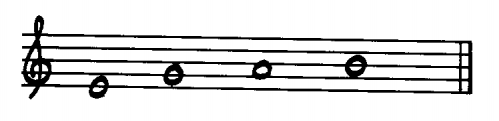
The first exercise I came across while reading Composing Music: A New Approach was to write a melody for a four-tone flute, immediately after reading the list of General Rules for the Exercises that is presented beforehand. The exercise appeared simple (and probably should have been simple, had it not been for my inability to become satisfied with anything I wrote at first), as it requires simply to write a melody using these tones:
The exercise also demands that we use a particular rhythm for each measure:
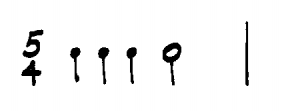
And suggests that we “occasionally repeat a measure, either consecutively or after intervening measures” to unify our melody and give it shape, besides suggesting that we do not use all the four tones all the time and study the expressive possibilities of each tone with relation to the others. Now, in my attempts at this exercise I tried to pay special attention to these relationships between the tones, but I could not consciously discover much beyond what appears to be the fact that the note E should be at the beginning and at the end of the melody, which if I understand correctly is hinted at in hint 3: “Melodies with no harmony or accompaniment should be started and ended on the first tone of the scale (the tonic) and in the same octave as the first tone.”
The matter of the octaves also produced some confusion as to how I should understand the tones, as I was not sure if I could use other octaves of those same tones, but I cleared my doubts when I peeked at the following exercise, where permission to use other octaves is explicitly given and thus implying that in the previous one this is not allowed. I got rid of the notes in wrong octaves that I had written in speculation as to that doubt and resumed moving the four tones about in MuseScore 3. After much time, I accomplished the following:

Which appears to meet the suggestions in the exercise: it contains a measure that repeats once throughout and the appearance of a note B is postponed until measure 3. I wrote this melody with the aid of the Virtual Piano (virtualpiano.net), by pressing the appropriate keys somewhat arbitrarily at first and hoping they would sound melodic and then transcribing the notes to MuseScore. The authors of the book advise against this, suggesting instead that we write for string instruments or wind instruments, so I took the care afterwards to switch to a flute or violin voice in MuseScore when I wrote the melodies in the software.
With regard to the melody, I must say I was unimpressed by how it turned out and by the point I managed to write it I had already attempted melodies of many another type, with more repeated notes, leaps in different places among other things I experimented with, so I was getting a bit irritated that I was not achieving much that seemed very interesting. I did feel, however, that in my getting irritated I was forcing myself to pay attention to details, and helping develop a sense of detail is one of the things the book aims to accomplish by subjecting to limited resources.
I kept starting over and eventually came up with what I think is a better melody. I increased the tempo and wrote something based on repeating a particular sequence of notes:

This new melody noticeably has something in common with the older one, for instance, it is the note B that is once more postponed. This time I was more or less led into the overall shape of the melody by pressing the keys in the piano more rapidly and, furthermore, I had been intending to achieve something that vaguely resembled a dance of some sort (perhaps drawing some inspiration from the description in the exercise of the warlike tribe ruled by Edrevol). The degree to which I succeeded in doing this is surely debatable, but I guess most people would agree that this melody is more concise and perhaps makes more sense (if it is correct at all to say any of this, but hopefully you get the idea) than the previous one, which at some points in my view does not appear to move in any direction in particular.
At the end of it all, I had the feeling I could have got more out of the exercise by further experimenting with how the melody seems to move or stay still by postponing different tones and actually taking note of how they contribute to the melody. Perhaps the readers of this post will have something to comment on this and maybe I would like to write on this matter on a later post when I have had more experimentation and time to think it all through in more detail. Certainly it would take a lot more than what I gave in my attempts to exhaust all the possibilities (which seem to be plenty) that come with creating melodies for this four-tone flute.
 Galbraith's Blog